
What is Ozoroa Insignis?
Ozoroa Insignis is an herbal medicine tree that grows natively in most parts of Africa. It has many synonyms, including Heeria Insignis and Ozoroa reticulate. Ozoroa Insignis’ most popular vernacular name is the tropical resin tree.
In the areas where Swahili is a native language, this tree is known as Mzabibu mwitu. Scientifically, Ozoroa insignis belongs in the Anacardiaceae family.
Ozoroa Insignis Physical Properties
Ozoroa Insignis grows up to fifteen meters tall. It is an extremely hard dark red wood. Because of this physical property, Ozoroa tends to resist termite damage. Although the tree is hard, its timber is easy to cut and shape in different ways.
That is why Ozoroa Insignis is a leading raw material for construction projects and furniture works. People also produce firewood and charcoal from its stems and branches. In some traditional cultures, Ozoroa’s stem charcoal is a preservative for milk. It works as a fridge.
In traditional medicine across Africa, Ozoroa Insignis’ bark, leaves, and roots have healing powers. From throat to chest to skin infections, this is one of the most crucial trees across the continent.
According to scientific research, extracts from the medicinal parts of the Ozoroa shrub boast antimicrobial and anti-inflammatory traits. Its active compounds such as bioactive lipids exhibit worm detoxification effects. In the East Africa regions such as Kenya, this shrub plays a significant role in tonsillitis treatment.
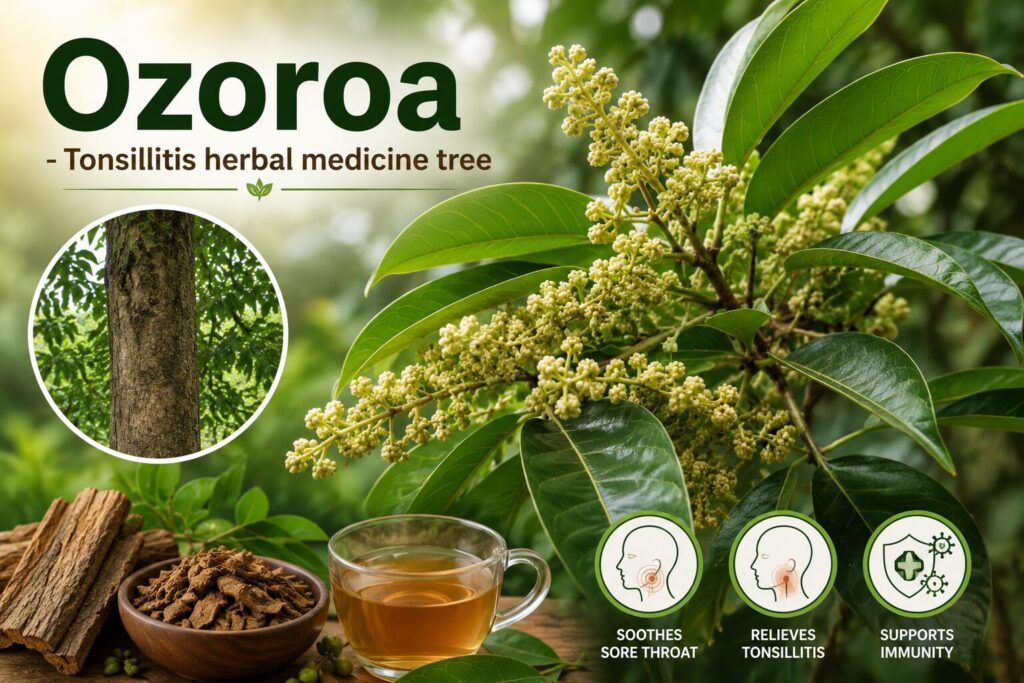
Ozoroa Insignis Medicinal Benefits – Action on Tonsillitis and Throat infections
Ozoroa is a popular tree species among the African herbalists. Modern studies support and validate the medical applications of Ozoroa Insignis. One of its most accurate uses in East Africa regions (Kenya and Sudan) is the treatment of tonsillitis and threat infections.
Its bark and root produce extracts with substantial antimicrobial potency against staphylococcus aureus bacteria. This bacterium causes many throat infections and tonsillitis. Its ethyl acetate extracts stop this bacteria’s activity by inhibiting its growth, replication, and transmission.
This plant tends to block certain enzymes (extracellular proteases) that staphylococcus aureus utilizes to destroy the throat tissue and spread into deeper areas. That is how it prevents tonsillitis from getting worse.
Ozoroa Insignis Other Medicinal Properties
Apart from stopping the proliferation and spread of Staphylococcus aureus, Ozoroa Insignis has anthelmintic powers. In short, it can effectively work as a detoxifier for stomach parasites.
In traditional medicine across Africa, herbalists use Ozoroa’s bark and root extracts to expel intestinal parasites such as hookworms and tapeworms and treat schistosomiasis. It is thought that the tree’s ginkgoic and anacardic acids are the compounds that push flat worms out of the body.
Decoctions from the tree have further uses in these African cultures. For instance, they generally use these to treat the infections of the liver, kidney, chest, and stomach.
Preparation and Administration
Many traditional herbalists and healers make decoctions from the bark of the Ozoroa tree. They boil the bark to make herbal tea for drinking or swishing in the mouth.
In the case of swollen and infected tonsils, one can swish and gargle the tea to stop the bacteria from growing. Another way that Africans use Ozoroa Insignis is to chew its twigs gradually.
The sap from the twigs enters the throat area directly. It soothes the inflamed areas while stopping tonsillitis from worsening.
Conclusion
Are you searching for a natural tonsillitis treatment in Kenya? Whether you are an adult looking for a tonsillitis cure for yourself or a child, you can trust the Ozoroa Insignis protocol by Dr. Mike Mwendwa of Kee Botanical Gardens.
His natural medicine follows the best practices during production, packaging, and distribution. You can consult him about your tonsillitis struggle. He will guide you on the correct Ozoroa herbal tonsillitis medicine dosage to use based on the severity of your illness.